

For many adults, healthcare training does not really begin on the first day of class. It begins earlier — when they receive an orientation packet, look over unfamiliar healthcare terms, wonder what the classroom will feel like, and try to imagine themselves working with patients.
Certified Nursing Assistant (CNA) and allied health programs are often fast-paced. Learners are expected to absorb new vocabulary, follow multi-step instructions, understand workplace expectations, and communicate clearly in care settings. For adult learners who are returning to school, learning English, changing careers, or building foundational literacy skills, the first few weeks can feel overwhelming.
That gap between interest and readiness is exactly where pre-training support matters.
The Readiness Gap Is Real
Adult learners entering healthcare pathways bring motivation, life experience, and strong reasons for wanting to succeed. But many also enter with different levels of academic preparation, English proficiency, digital confidence, and exposure to healthcare vocabulary.
Recent national data show that adult literacy remains a major challenge. The 2023 Program for the International Assessment of Adult Competencies found that 28% of U.S. adults ages 16–65 scored at or below Level 1 in literacy, an increase from 19% in 2017 (National Center for Education Statistics, 2024). For healthcare training programs, this matters because learners are not only reading general content — they are learning specialized language tied to safety, dignity, communication, and care.
At the same time, the healthcare workforce needs more trained workers. The Bureau of Labor Statistics projects approximately 216,200 annual openings for nursing assistants and orderlies over the next decade, largely due to turnover and workforce exits (Bureau of Labor Statistics, 2024). Preparing more adults to enter and persist in healthcare training is both an education issue and a workforce issue.
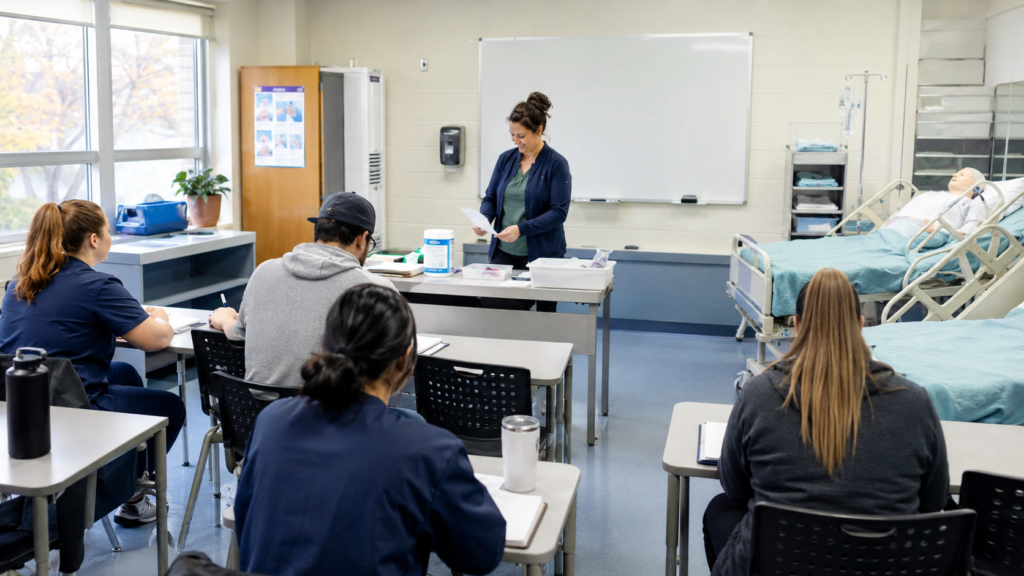
Vocabulary Is More Than Memorization
Healthcare vocabulary is not just a list of words to memorize. Learners need to recognize terms, connect them to real situations, and understand how those terms are used in communication with patients, residents, instructors, and supervisors.
For example, a learner may memorize the term “pulse oximeter,” but still need practice recognizing the object, understanding when it is used, and explaining its purpose in simple language. That kind of readiness requires more than a textbook definition. It requires repeated exposure, context, practice, and confidence-building.
Research in adult learning emphasizes the importance of instruction that is relevant, practical, and connected to immediate goals (Knowles et al., 2015). Situated learning theory also suggests that learners benefit when practice is connected to authentic, workplace-like contexts (Lave & Wenger, 1991). For pre-CNA learners, this means vocabulary and communication practice should feel connected to the healthcare environments they are preparing to enter.
Why Mobile-First Readiness Matters
Many adult learners are balancing school with work, family, transportation, and other responsibilities. Readiness support has to fit into real life. Long modules, expensive hardware, or training tools that require special scheduling can create barriers.
Mobile-first learning offers a practical path. Learners can practice in short sessions before class, between shifts, on public transportation, or at home. Research on mobile learning supports its potential for flexible access, while also emphasizing the need for careful usability and implementation design (Crompton & Burke, 2018; Dunleavy et al., 2019).
Short, focused learning activities can also support healthcare learners. A scoping review of microlearning in health professions education found that microlearning has been associated with outcomes such as knowledge, confidence, engagement, and retention (De Gagne et al., 2019). For adult learners preparing for CNA training, short practice can help reduce the feeling of being overwhelmed before formal instruction begins.
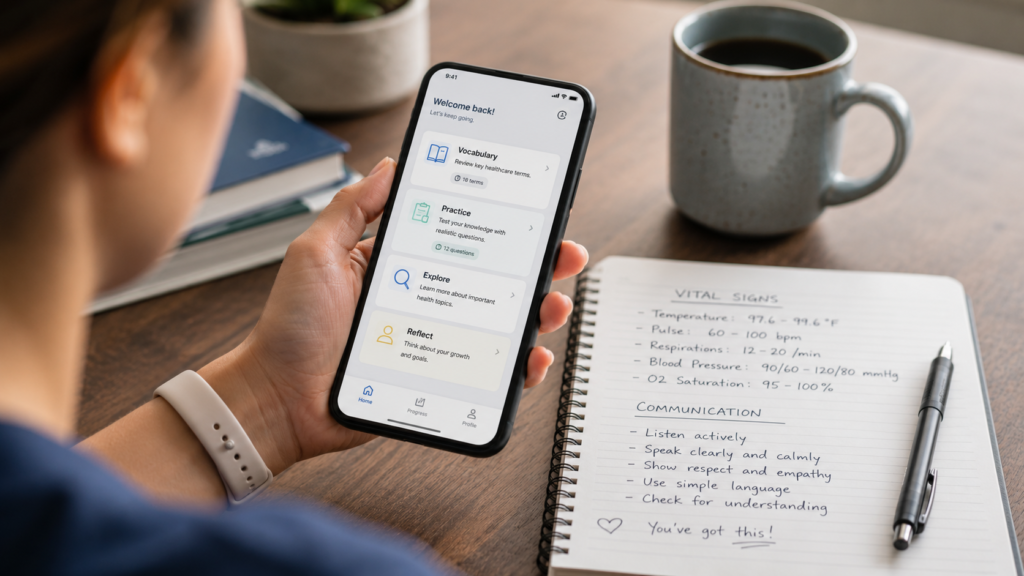
Building Confidence Before Day One
Pre-CNA readiness support should not replace classroom instruction, clinical training, or instructor expertise. Instead, it should help learners arrive better prepared to participate.
That means helping learners:
- recognize common healthcare vocabulary;
- practice simple workplace communication;
- connect terms to realistic care situations;
- build confidence before class begins;
- reflect on what they are learning;
- and give educators better visibility into where learners may need support.
Simulation-based education research suggests that well-designed simulation can support confidence, communication skills, and learning outcomes in healthcare education (Chernikova et al., 2020; Foucault-Fruchard et al., 2024). For adult learners, even lightweight, mobile-accessible practice can help bridge the space between unfamiliar terms and real-world healthcare readiness.
The Opportunity
The goal is not to make learners “trained” before they begin. The goal is to help them feel less lost when training starts.
When adult learners enter CNA or allied health programs with stronger vocabulary recognition, more confidence, and a clearer sense of what to expect, instructors can spend less time only remediating basics and more time building skills. Learners can begin with a stronger foundation. Programs can support persistence earlier in the pathway.
At Vizulingo, we believe pre-CNA readiness should be practical, mobile-first, and grounded in how adult learners actually learn. By combining short practice, healthcare vocabulary, guided reflection, and workplace-connected scenarios, readiness support can help learners take the first step with more confidence.
References
Bureau of Labor Statistics, U.S. Department of Labor. (2024). Occupational outlook handbook: Nursing assistants and orderlies. https://www.bls.gov/ooh/healthcare/nursing-assistants.htm
Chernikova, O., Heitzmann, N., Stadler, M., Holzberger, D., Seidel, T., & Fischer, F. (2020). Simulation-based learning in higher education: A meta-analysis. Review of Educational Research, 90(4), 499–541. https://doi.org/10.3102/0034654320933544
Crompton, H., & Burke, D. (2018). The use of mobile learning in higher education: A systematic review. Computers & Education, 123, 53–64. https://doi.org/10.1016/j.compedu.2018.04.007
De Gagne, J. C., Park, H. K., Hall, K., Woodward, A., Yamane, S., & Kim, S. S. (2019). Microlearning in health professions education: Scoping review. JMIR Medical Education, 5(2), e13997. https://doi.org/10.2196/13997
Dunleavy, G., Nikolaou, C. K., Nifakos, S., Atun, R., Law, G. C. Y., & Tudor Car, L. (2019). Mobile digital education for health professions: Systematic review and meta-analysis by the Digital Health Education Collaboration. Journal of Medical Internet Research, 21(2), e12937. https://doi.org/10.2196/12937
Foucault-Fruchard, L., Bertaux, É., Mouton, A., Bourmaud, A., Moriceau, G., & Brédart, A. (2024). The impact of using simulation-based learning to further develop communication skills among health and social care students and professionals: A systematic review. BMC Medical Education, 24, Article 1482.
Knowles, M. S., Holton, E. F., III, & Swanson, R. A. (2015). The adult learner: The definitive classic in adult education and human resource development (8th ed.). Routledge.
Lave, J., & Wenger, E. (1991). Situated learning: Legitimate peripheral participation. Cambridge University Press.
National Center for Education Statistics. (2024). Highlights of the 2023 U.S. PIAAC results web report (NCES 2024-202). U.S. Department of Education, Institute of Education Sciences. https://nces.ed.gov/surveys/piaac/2023/national_results.asp