

The Gap Between Instruction and Readiness
Healthcare training does not begin and end with classroom instruction. For many adult learners, there is a critical space between learning about a healthcare career and feeling ready to participate in one.
That space is the missing middle.
For Certified Nursing Assistant (CNA) and allied health learners, the missing middle often shows up before or during the first weeks of training. Learners may be motivated and committed, but still unsure about healthcare vocabulary, workplace communication, classroom expectations, and how to connect new terms to real care situations.
A learner may understand that CNA training is the right next step, but still wonder: What will the words mean? What will the instructor expect me to know? What if I fall behind before I even understand the basics?
That is where readiness support matters.
Classroom Instruction Is Essential, But It Cannot Do Everything
CNA and allied health instructors already have a lot to cover. They teach skills, safety, communication, professionalism, infection control, patient dignity, and preparation for testing or clinical expectations. In many programs, the timeline is short and the pace is fast.
That leaves limited time to slow down for every learner who needs extra vocabulary support, more repetition, or more confidence before participating.
This is especially important for adult learners who may be returning to school after years away, learning English, changing careers, working while attending class, or balancing family responsibilities. These learners do not lack motivation. They often need more accessible ways to prepare, practice, and build confidence before the stakes feel too high.
Adult learning theory emphasizes that adults learn best when instruction is relevant, practical, and connected to immediate goals (Knowles et al., 2015). For healthcare learners, readiness support should connect directly to the situations they are preparing to face: communicating with patients, recognizing common healthcare terms, understanding basic care environments, and reflecting on what they are learning.

Confidence Comes From Practice, Not Just Exposure
It is one thing to hear a healthcare term in class. It is another thing to recognize it, understand it in context, and feel comfortable using it.
For example, a learner might hear the term “vital signs” during orientation. But readiness means more than recognizing the phrase. It means beginning to understand related terms like pulse, blood pressure, temperature, respirations, and oxygen saturation. It also means connecting those words to the real tasks and conversations learners will encounter in training.
That kind of confidence usually requires repeated exposure and guided practice.
Scaffolding theory supports the idea that learners benefit from temporary instructional supports that help them complete tasks they could not yet complete independently (Wood et al., 1976). In technology-enhanced learning environments, scaffolding can help learners navigate complex content by breaking tasks into smaller steps, offering support at the right time, and gradually increasing complexity (Sharma & Hannafin, 2007).
For adult healthcare learners, this could mean starting with simple vocabulary, then moving into short practice scenarios, then reflecting on what they learned. The goal is not to replace the instructor. The goal is to help learners arrive more ready to engage with instruction.
The Missing Middle Is Also A Workforce Issue
Healthcare employers and training programs need more people to enter and complete workforce pathways. But readiness gaps can make that harder.
When learners feel overwhelmed early, they may disengage, miss opportunities to ask questions, or lose confidence before they have had a fair chance to succeed. This does not just affect the learner. It affects programs, instructors, employers, and communities that need more trained healthcare workers.
Readiness support can help by giving learners a lower-pressure place to practice before or between formal instruction. It can also give educators better insight into where learners may be struggling, including vocabulary, confidence, engagement, or completion of practice activities.
Why Mobile Readiness Support Fits This Gap
Many adult learners already use their phones throughout the day. A mobile-first approach can make readiness practice easier to access without requiring special equipment, long computer lab sessions, or additional classroom time.
Mobile learning research supports flexible access to education while also emphasizing the importance of usability, learner context, and implementation design (Crompton & Burke, 2018; Dunleavy et al., 2019). Short, focused learning activities also align with microlearning research in health professions education, where brief learning experiences have been associated with knowledge, confidence, engagement, and retention (De Gagne et al., 2019).
For pre-CNA and allied health learners, this matters because readiness can happen in small moments: before class, on a bus, during a break, or at home after work.
Those small moments can add up.
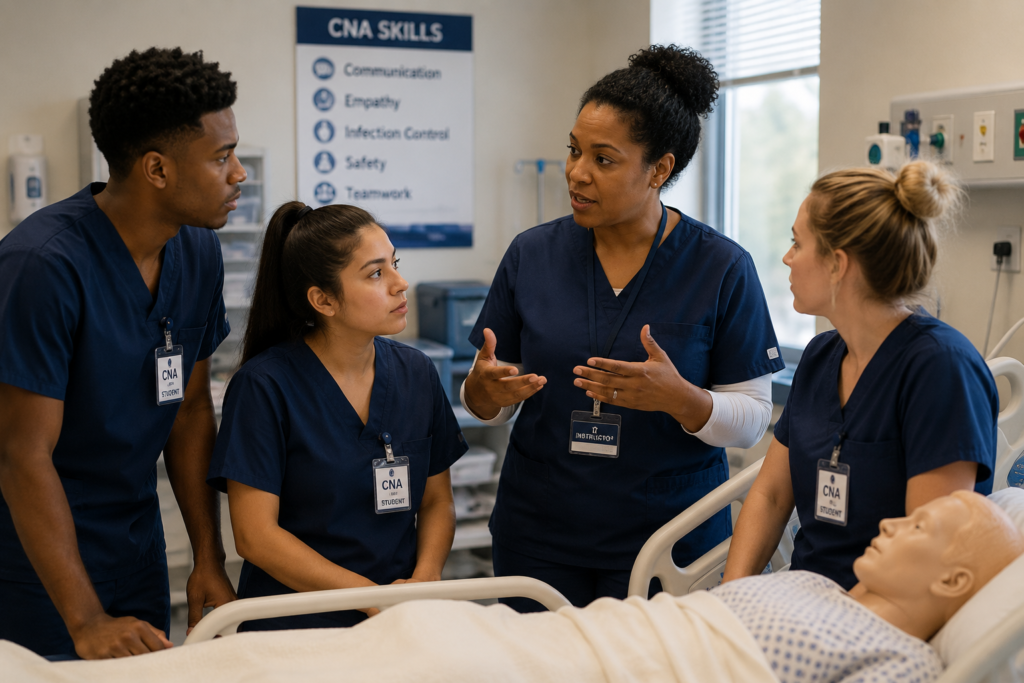
What A Readiness Layer Can Do
A readiness layer between interest and formal training can help learners:
- build healthcare vocabulary before class begins;
- practice simple workplace communication;
- connect terms to realistic care situations;
- reflect on what they are learning;
- develop confidence through repetition;
- and give instructors better visibility into where support may be needed.
Simulation-based education research suggests that well-designed simulation can support healthcare learners’ confidence, communication skills, and learning outcomes (Chernikova et al., 2020; Foucault-Fruchard et al., 2024). For adult learners, mobile-accessible, scenario-based practice can offer a practical way to connect classroom preparation with workplace readiness.
Moving From Interest To Readiness
The missing middle is not about turning learners into healthcare workers before training begins. It is about helping them become more prepared to begin.
That distinction matters.
A learner does not need to master everything before the first day of class. But they can benefit from knowing common terms, practicing basic communication, understanding what to expect, and feeling more confident walking into the room.
At Vizulingo, we believe adult healthcare learners deserve readiness support that is practical, mobile-first, and connected to real workforce pathways. By helping learners build vocabulary, confidence, and reflection before they are overwhelmed, programs can create a stronger bridge between classroom instruction and clinical confidence.
References
Chernikova, O., Heitzmann, N., Stadler, M., Holzberger, D., Seidel, T., & Fischer, F. (2020). Simulation-based learning in higher education: A meta-analysis. Review of Educational Research, 90(4), 499–541. https://doi.org/10.3102/0034654320933544
Crompton, H., & Burke, D. (2018). The use of mobile learning in higher education: A systematic review. Computers & Education, 123, 53–64. https://doi.org/10.1016/j.compedu.2018.04.007
De Gagne, J. C., Park, H. K., Hall, K., Woodward, A., Yamane, S., & Kim, S. S. (2019). Microlearning in health professions education: Scoping review. JMIR Medical Education, 5(2), e13997. https://doi.org/10.2196/13997
Dunleavy, G., Nikolaou, C. K., Nifakos, S., Atun, R., Law, G. C. Y., & Tudor Car, L. (2019). Mobile digital education for health professions: Systematic review and meta-analysis by the Digital Health Education Collaboration. Journal of Medical Internet Research, 21(2), e12937. https://doi.org/10.2196/12937
Foucault-Fruchard, L., Bertaux, É., Mouton, A., Bourmaud, A., Moriceau, G., & Brédart, A. (2024). The impact of using simulation-based learning to further develop communication skills among health and social care students and professionals: A systematic review. BMC Medical Education, 24, Article 1482.
Knowles, M. S., Holton, E. F., III, & Swanson, R. A. (2015). The adult learner: The definitive classic in adult education and human resource development (8th ed.). Routledge.
Lave, J., & Wenger, E. (1991). Situated learning: Legitimate peripheral participation. Cambridge University Press.
Sharma, P., & Hannafin, M. J. (2007). Scaffolding in technology-enhanced learning environments. Interactive Learning Environments, 15(1), 27–46. https://doi.org/10.1080/10494820600996972
Wood, D., Bruner, J. S., & Ross, G. (1976). The role of tutoring in problem solving. Journal of Child Psychology and Psychiatry, 17(2), 89–100.